Quick answer: Office shoes should match the workplace's highest recurring level of formality while supporting the actual commute and workday. Conservative offices favor black or dark-brown Oxfords and Derbies; business-casual environments can add loafers, brogues, suede, and discreet hybrids. The shoe should handle repeated outfits without becoming the loudest element.
The direct answer for How to Choose Dress Shoes for the Office
Office shoes should match the workplace's highest recurring level of formality while supporting the actual commute and workday. Conservative offices favor black or dark-brown Oxfords and Derbies; business-casual environments can add loafers, brogues, suede, and discreet hybrids. The shoe should handle repeated outfits without becoming the loudest element.
Start with fit and daily movement, then choose a silhouette. Someone walking from transit needs traction and flexibility, while a mostly seated worker can prioritize a thinner, more traditional sole. A two-pair rotation is more useful than a single expensive pair worn without recovery.
How workplace formality changes the decision
Law, finance, government, and executive client settings usually reward plain or cap-toe leather lace-ups with dark soles. Moderate broguing may be acceptable, but bright contrast and sneaker-like bottoms lower authority. Look at senior colleagues and client expectations rather than relying only on a company-wide casual label.
Creative and technology offices allow wider style range, though meetings can still require a polished option. A dark loafer or minimalist dress sneaker may cover ordinary days, while a black or brown Derby remains available for presentations. Build to the most formal predictable task, not the most relaxed Friday.
How commute changes the decision
Sidewalk distance, transit stairs, parking lots, and weather can turn a delicate sole into a daily problem. Rubber or combination soles provide traction and resist moisture better than smooth leather in many commutes. The edge can remain discreet enough for tailoring when the upper is restrained.
Some commuters wear a separate travel shoe, but changing at the desk requires storage and planning. If one pair must do both jobs, prioritize stable grip, correct flex, and an upper that is easy to maintain. Check whether water-resistant claims apply to the selected variation rather than the product family generally.
How rotation changes the decision
Alternating shoes lets moisture leave the lining and reduces repeated stress on the same sole and foot areas. A practical starting rotation is one black or dark formal lace-up plus one brown Derby or loafer. Together they cover more trousers and allow each pair a full day to recover.
Rotation can also divide work by conditions. Use the grippier pair for wet commutes and the more refined pair for presentations. Record which shoes remain comfortable through long meetings or standing events instead of assuming the higher-priced model should be the default.
How and meeting schedule changes the decision
A day of internal desk work tolerates a more relaxed loafer or hybrid than a client pitch, interview panel, or formal dinner. Review the calendar when choosing the morning pair. Keeping a maintained dark lace-up at the office can cover unexpected high-stakes meetings.
Travel between buildings and long reception lines increase the need for comfort and traction. Shoes should remain quiet on hard floors and secure on stairs. A visually formal pair that causes limping by afternoon undermines the professional effect it was meant to create.
Common mistakes to avoid with How to Choose Dress Shoes for the Office
Buying only for carpeted showroom comfort ignores the commute and standing load. Another mistake is adopting an extremely casual shoe because one colleague does, without considering role seniority or client contact. Dress-code latitude is contextual.
Do not wear the same pair five days in a row if rotation is possible. Persistent moisture shortens lining life and can worsen odor. Even a budget second pair can improve recovery and reveal which shape better suits different days.
A practical before-you-buy checklist
Map formal meetings, ordinary desk days, commute distance, floors, and weather. Choose a color and style that works with at least three regular trousers, then assess width, flex point, grip, and care needs. Confirm that the exact sole and material match the listing selected.
Test late in the day with office socks and walk on a clean hard surface. Sit, stand, climb stairs, and watch for heel lift or forefoot pressure. Plan how the pair fits into a rotation before treating it as an everyday solution.
CURRENT AMAZON OPTIONS
Use these as relevant comparison points.
As an Amazon Associate, we earn from qualifying purchases. Amazon links open the exact listing so you can confirm current size, color, price, and availability.

Bruno Marc · Black
Bruno Marc Goldman-01 Square-Toe Dress Shoes
Goldman-01 uses a square toe, lace-up closure, and smooth synthetic upper.

Bruno Marc · Black
Bruno Marc Italy Men's Oxford Dress Shoes
Plain-toe dress shoe with a breathable lining and latex insole.

Bruno Marc · Black
Bruno Marc KnitFlex Breeze
A breathable hybrid that reads polished without pretending to be a formal Oxford.
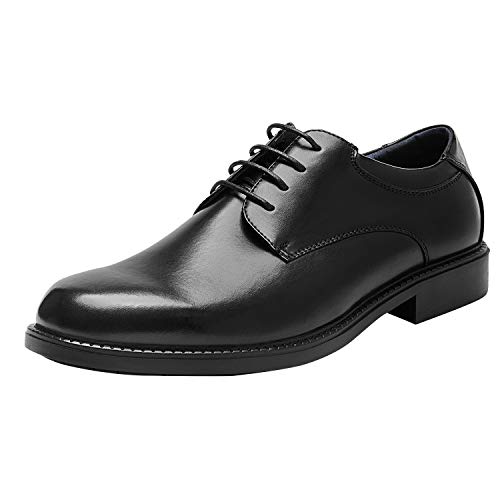
Bruno Marc · Black
Bruno Marc Men's Business Derby Lace-Up Shoes
Classic open-lacing derby with a cushioned latex insole and TPR outsole.
QUICK ANSWERS
Questions shoppers ask next.
What is the first thing to check for how to choose dress shoes for the office?
Check the most formal recurring meeting and the real commute. The shoe must satisfy both the dress-code ceiling and the traction, walking, and standing demands of an ordinary day.
Which common mistake changes the How to Choose Dress Shoes for the Office decision most often?
Choosing for appearance while ignoring commute surfaces and daily hours causes many failures. A formal upper cannot make an unstable, painful sole practical for repeated workdays.
How can you confirm workplace formality for “How to Choose Dress Shoes for the Office” before the return window closes?
Compare the pair with what senior colleagues wear during client-facing meetings, not only casual internal days. Test it with the actual suits or trousers and keep a darker lace-up if the role crosses formality levels.
What nearby office choice should you compare while deciding “How to Choose Dress Shoes for the Office”?
Compare a traditional cap-toe Oxford with a rubber-soled Derby or loafer. The Oxford raises formality, while the alternative may provide better adjustment and commute performance.