Quick answer: A true wide size adds room across targeted areas while preserving the intended length and flex position. Sizing up mainly adds length and may also enlarge the heel, creating slip without solving pressure at the ball. Width letters are therefore more useful than an oversized standard width.
True wide sizing versus simply sizing up
A true wide size adds room across targeted areas while preserving the intended length and flex position. Sizing up mainly adds length and may also enlarge the heel, creating slip without solving pressure at the ball. Width letters are therefore more useful than an oversized standard width.
Check where the forefoot sits relative to the widest part of the shoe. If the toes have spare length but the joints press against the sides, the answer is width or last shape, not another half size longer.
Round, almond and chisel toe shapes
Round toes generally provide the most forgiving outline, especially when the shoe stays broad through the ball. A soft almond can work when its taper begins ahead of the toe joints. Chisel toes vary: some are spacious, while others narrow sharply along the little toes.
Toe appearance does not guarantee internal room. Compare outsole shape and overhead photos, then test whether all toes can lie flat. Decorative length in a pointed shoe cannot compensate for insufficient width or height.
Derby versus Oxford adjustability
A Derby's open quarters can spread across a broad or high-volume foot, making it the easier starting point for many wide-foot shoppers. The opening also simplifies entry without forcing the foot through a tight throat.
An Oxford can still fit wide feet when offered in the correct width and built on a generous last. The facings should approach one another naturally rather than forming a strained V. Choose by actual fit, not by a belief that all Oxfords are narrow.
Removable footbeds and internal volume
A removable footbed can create space for an orthotic or a thinner replacement insert, but it does not change the outsole width. Removing a thick insole may relieve top pressure while leaving the toe joints crowded against the sidewalls.
Check whether the listing explicitly says the footbed is removable and whether the shoe remains stable after substitution. Added depth is valuable only when the heel stays seated and the foot is supported at the correct flex point.
Pressure-point fit test
Wear the shoes late in the day and walk long enough for the foot to settle. Inspect the little-toe joint, big-toe joint, outer midfoot, and instep for concentrated pressure. The upper should contain the foot without visible bulging over the welt.
Numbness, burning, tingling, or a stretched-looking lacing gap means the shoe is not merely snug. Compare a true wide or extra-wide size while the soles remain returnable. Leather relaxation is too limited to correct severe compression.
Brand-by-brand width-shopping framework
Begin with brands that publish width options on the exact model, then compare their charts and fit notes rather than assuming every E or W is equivalent. A brand may use several lasts, so success in one shoe does not guarantee identical fit across its catalog.
Order the model, length, width, and color carefully because marketplace listings can group variations. Keep a record of the successful last and size for future purchases. Return policies and available adjacent widths are part of the buying decision.
CURRENT AMAZON OPTIONS
Use these as relevant comparison points.
As an Amazon Associate, we earn from qualifying purchases. Amazon links open the exact listing so you can confirm current size, color, price, and availability.

Rockport · Black
Rockport Margin Oxford
A practical plain-toe option for shoppers who prioritize familiar fit and subdued styling.

Clarks · Dark tan leather
Clarks Tilden Cap Oxford
A classic cap-toe lace-up offered by Amazon in regular and wide sizing.
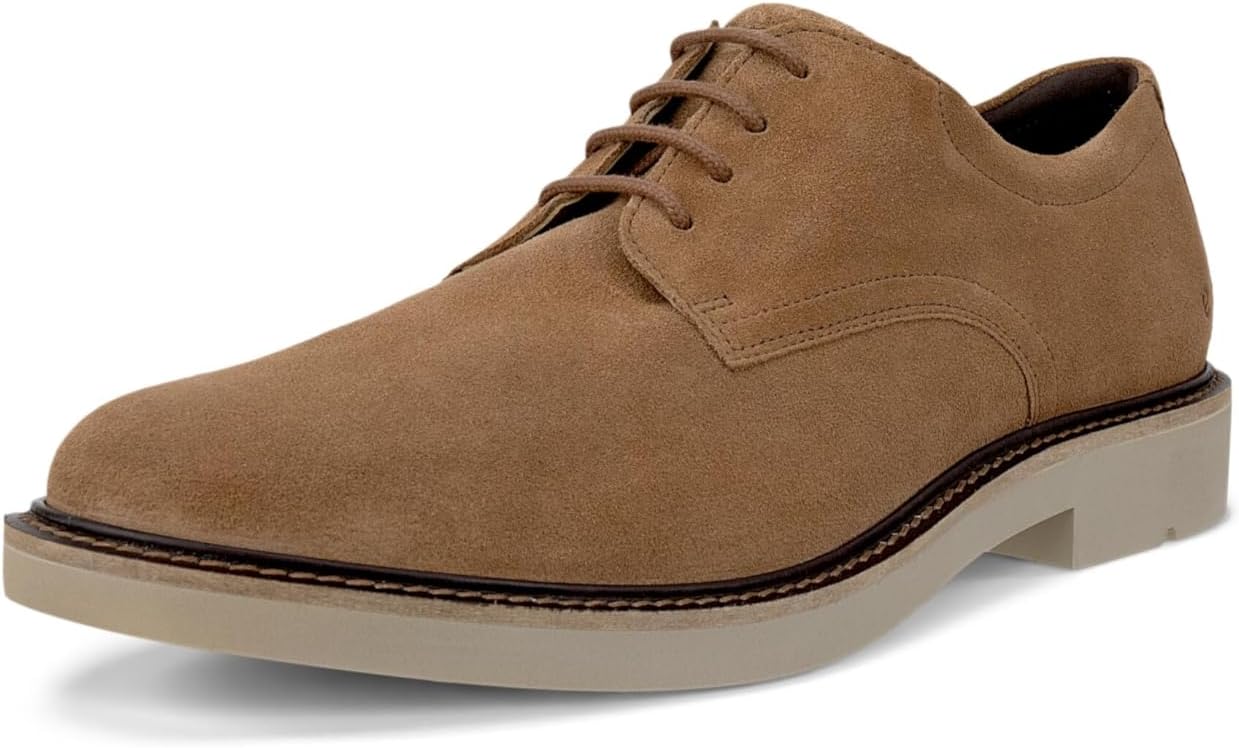
ECCO · Black
ECCO London Plain-Toe Derby
A round-toe derby profile with a removable dual-fit insole on the Amazon listing.
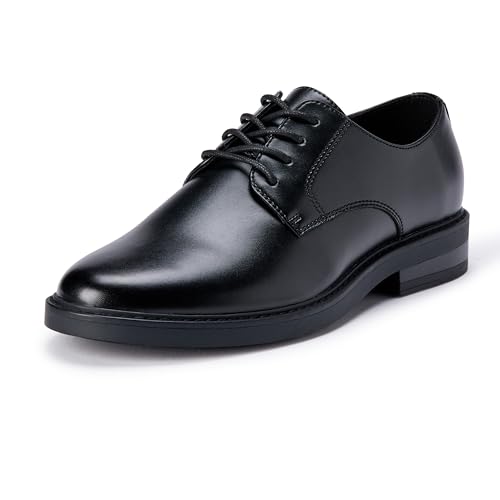
Amazon Essentials · Black
Amazon Essentials Men's Round-Toe Derby Dress Shoes
Open-lacing round-toe derby with an active-response foam cushioned insole.
QUICK ANSWERS
Questions shoppers ask next.
Are Derby shoes better for wide feet?
Often, because open lacing provides more adjustment across the forefoot and instep. A Derby still needs the correct outsole width and last; open quarters cannot rescue a narrow base.
Should wide feet size up in dress shoes?
Usually not as the first solution. Sizing up moves the flex point and can loosen the heel. Select a true wider width or a roomier last while keeping the correct length.
What toe shape is best for wide feet?
A round or gently almond-shaped toe on a broad last is the safest starting point. The taper should begin ahead of the toe joints, and the toes should lie flat without side pressure.
Which dress-shoe brands offer wide widths?
Availability changes by model, but comfort-oriented brands such as Rockport, Clarks, ECCO, Florsheim, and some Cole Haan lines commonly list width choices. Verify the exact Amazon variation because a brand's entire range does not share one width offering.